
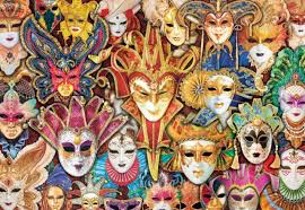
We all wear Masks. Oscar Wilde said, “Be yourself, everyone else is taken. In order to be oneself, one has to take risks, to accept that one is not perfect and to be courageous enough to say what one really thinks”.
Masks have become a daily part of our life and often a self-defense mechanism. Wearing masks camouflages our natural personality or behavior to conform to social pressures, abusers, bullies, harassment, and how we feel about ourselves. It is an imposter syndrome, fearing others will find us out. We all wear masks at one time or another, which can be influenced by authoritarian figures, parents, rejection, and emotional, sexual, or physical abuse. We use this as a coping mechanism which we do subconsciously or as a trauma response. Connected to performance behaviors from wanting to fit into society. It disguises emotions that an individual might feel others would perceive as inappropriate, such as with anger or jealousy. Conforming to work settings, job interviews, dates or around people from different backgrounds which requires different performances and switching masks and different masking behaviors.
The reasons for wearing a mask can be to hide fear, anxiety, to be liked and accepted, to hide vulnerability, sadness and depression, anger. We manufacture certain traits in our behaviors to hide secrets or things we are ashamed of, including our own authentic self; portraying what we think is a better image of ourselves. Social media has fostered the growth of wearing masks with social, cultural, political pressures. This is harmful for developing healthy interactions with others and forming healthy relationships. This is how we often become attached to our childhood and are stuck in our family. We don’t want to be exposed and become very vulnerable and fearful. We also try to impress others by pretending to be someone we aren’t. So, we put on that false face, the Mask.

Masks help us to fit into society and to hide from others. Which can be very exhausting causing stress, anxiety and depression from not letting ourself truly Be. Different types of masks we wear to hide our personality is with words, facial expressions, body language and actions.
The many different personality Masks we may wear are:
- Suppression Mask; hiding difficult experiences and situations such as death, divorce, loss of a job, etc. Avoiding burdening others.

- Martyr or victim Mask; such as a people pleaser, sacrificing their own needs for the needs of others and to please others. But also feeling helpless, trapped and victimized by other’s demands.
- Alpha Mask; to prove dominance, feeling someone is questioning your authority or feeling attacked.
- Bully Mask; feeling self-doubt or have been abused, as a bully want to keep people away. Acting out or coercing others to overcompensate for low self-image.
- Manipulation Mask; a person that is unpredictable in social settings, such as cheaters in order to not be found out.
- Deception Mask; the mask of an actor, used to purposely deceive others, to conceal a truth, to outmaneuver someone in power such as at work.
- Comedian/Humor Mask; to avoid being laughed at by others, fear, sadness, etc. Laughing at yourself to disassociate from feeling whatever emotions are coming up. A defense mechanism.
- Passive-Aggressive Mask; a deliberate way to hide feelings of anger, to avoid exploding, which ironically eventually develops into a greater degree of anger and upset.
- Calm Mask; this can be for many reasons such as to avoid exploding in anger or expressing something politically/ religiously/etc. unacceptable, or relieve social pressure.
- Vulnerability Mask; when not embracing/hiding your real self, unable to allow others in, afraid of intimacy.

- Stoic Mask; appearing to be calm and together, a façade, to appear strong and confident, to never show fear or weakness.
- Social Butterfly Mask; compensating for their feelings of insecurities by having many acquaintances but few real friends and lacking meaning relationships, keeping conversations superficial so they don’t expose their insecurities.
- OCD/Perfection Mask; no room for mistakes, overachieving, everything needs to be in its proper place, to gain external validation, to achieve a sense of security.
- Resilient Mask; an adaption to adversity and stress as a coping mechanism which leads to further upset and brushing things under the rug by not facing reality, instead of being truly resilient. It is an invincibility camouflage, they can do anything. When in fact we aren’t super heros, we are only human.
- Imposter Mask; afraid that people will find out who you really are, not comfortable being yourself, not accepting or loving yourself.
- Self-Depreciation Mask; having poor self-talk, joking about your weaknesses as a defense mechanism to avoid being hurt by others.
- Macho Man Mask; they can take care of themselves and don’t need others, having condescending attitudes, strong-willed and self-righteous, not able to show emotions, male pride.
- Avoidant Mask; withdraw and isolate from yourself and others out of fear of rejection, abandonment or judgment, no contact with others, putting up a wall around others.
- Conformist Mask; being a follower instead of a leader, following what everyone else is doing around you.


- Controlling Mask; to stay in control of everything and everyone around you, to feel in charge and take charge, for a sense of security, because your life has been out of control and others around you have been so out of control that you feel the need to control others and situations.
- People-Pleassing Mask; Co-Dependent! Needing validation and acceptance by others, to feel for and do for others because you don’t value yourself, put others others first instead of yourself.
- Social Mask: to be able to communicate more easily with others, usually through addiction (alcohol and drugs is most common), which keeps you from having meaningful conversations and relationships with other.


“To know thyself is the beginning of wisdom”. – Socrates
“Man is least himself when he talks in his own person. Give him a mask, and he will tell you the truth.” – Oscar Wilde
“He wears a mask, and his face grows to fit it.” – George Orwell
“Virtue has a veil, vice a mask.” – Victor Hugo
“The human face is, after all, nothing more nor less than a mask.” – Agatha Christie
“All the world’s a stage, and all the men and women merely players; They have their exists and their entrances; And one man in his time plays many parts,….”
William Shakespeare
Take off that Mask and free yourself! Discover who is really hiding behind that Mask. Take of journey of self discovery by gaining a deeper understanding of yourself by:
- Living mindfully/consciously through meditation and pausing throughout the day.
- Ask yourself who matters to you, who supports and loves you.
- Forgive others for their failures and short comings.
- Let go of expectations of others and yourself.
- Don’t try to fit in, it is overrated.
- Don’t try to have as many friends as possible, have a few close friends and value their friendship.
- Let go of unresolved emotions such as anger, grief, shame, etc.
- Realize you do not have to justify your worth.
- Become aware of your thoughts, actions/reactions and your physical self.
- Remember that life isn’t permanent and things change all the time.
- Be aware of any feelings that are coming up and not suppress them.
- Accept yourself as you are, be free to be Yourself!
- Realize you have a Voice and use Your Voice!
- Journal your thoughts and feelings will allow you to validate and remember them.
- Pursue your dreams and desires that are healthy.
- Don’t be afraid to try something new, get out of your comfort zone.
- Talk to others about how you are feeling, allow yourself to be vulnerable with healthy people.
- Ask what your inner critic is telling you.
- Practice changing your negative self-talk to positive self-talk by asking yourself realistic questions and if those thoughts and feelings are real, and if they are, how to accept or change them.
- Make a list of your strengths to remember them.
- Ask yourself what you are ashamed of and work on understanding what you can change and what you can’t.
- Accept people and situations for who and what they are.
- Ask yourself what you can learn from others and in the moment.
- Become aware of old patterns of behavior that are familiar, learned from childhood, unhealthy people in your life, negative situations that have influenced you.
- Understand what you are worried about and make changes.
- Understand what feelings are determining what you do to make a change.
- Make a daily gratitude list.
- Have self-care, doing what is good and healthy for yourself.
- Show up for Yourself!
- Have compassion and love yourself and remember you are perfectly and wonderfully made!

Thank you for allowing me to serve you. Remember to Live from your Heart! I look forward to serving you again.